|
The insulation you put in home is an important decision, as it maintains your comfort through summer and winter while keeping your utility bills low by reducing the amount of energy needed to keep your home at a constant temperature. Insulation does it's job in part through what is called an R-Value, which is a laboratory standard which determines an insulation's resistance to heat flow.
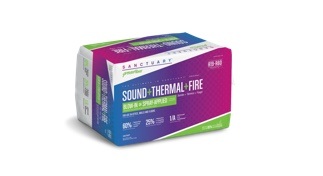
For example Applegate® has an R-Value of up to 3.8 per inch which is nearly twice that of some blown glass which have an R-Value as low as 2.2.

The Truth About R-Values is that while they are very important in determining the amount of insulation you need, they are not the whole story when it comes to the value of your insulation. Insulation that comes in batts require a lot of work, cutting and arranging in order to make sure that the insulation is securely snug against obtrusions such as pipes, wires and electrical outlets.
This manual labor typically results in compression of the batts and voids in the wall were the batts have not been properly installed. This compression and voids often result in a significant decrease in the batts effectiveness; not simply because of the reduced amount of glass in particular section of the wall but also by allowing for drafts within the wall. The gaps typical of batt insulation can allow for air movement - drafts, which can bring undesirable pollutants, noise, temperature and moisture into your home.
| "The most common insulation, fiberglass, does not stop air leakage. In older homes, dirty fiberglass is a telltale sign of air movement (it simply collects dirt like a filter). Certain types of insulation, such as dense-packed cellulose and certain foams, can be effective at reducing air flow as well as heat flow." |
Department of Energy, airsealing guide. |
|
Compression and splitting of batts because of a confined space or around obstacles is not easily fixed, you can not simply add another batt to fully insulate. Most insulation is basically trapped air - the more small pockets of trapped air, the higher the R-Value. Adding an additional batt in these situations results in even lower performance of the batts as they become even more compressed. Because pace is limited! So adding more means that the batt has to be jammed in even tighter, which further reduces performance! In other words, with Batts more can be less!
Applegate Cellulose Insulation® though, is either dry-blown or, damp-sprayed with Applegate's Spray-In Insulation System into walls, attics and between floors with compressed air; significantly reducing the opportunity for improper installation. Every nook and cranny which can be reached by the air is insulated, as the air is carrying the insulation fibers. This helps ensure that Applegate Insulation is installed for optimum performance! Applegate® provides peak performance from its great R-Value and also from how it is installed; by being a blown insulation it is custom fitted which reduces air infiltration. Being custom fit means that every cranny which could be reached by air, and thus a potential draft area, is filled with insulation.
Applegate's Spray-In Insulation System utilizes a dry organic adhesive which when activated at the application nozzle, provides a self supporting attic blanket and seamless block in the wall. The activation process of the Spray-In Insulation System also reduces the dust and helps reduce the amount of clean up that installers must deal with at the job site. It was developed in large part from Applegate's experiences as an insulation contractor!

In fact, Applegate Cellulose Insulation® so greatly restricts the amount of oxygen available during a fire, that it prevents a chimney effect in which hot air and fire can race up a wall to a ceiling or attic from which a fire can endanger the entire home. Compared to an un-insulated wall, a wall with Applegate Insulation can be up to 55% more resistant to fire.
|