Applegate Insulation

Frequently Asked Questions

How does Applegate recommend we insulate cathedral ceilings?

Applegate recommends that you dense pack non-ventilated cathedral ceilings. One building science study entitled Report On Roof And Wall Details: Upper Canada Post And Beam points out that cathedral ceilings are, "nothing more than well insulated exterior walls with insulating sheathing which is sloped." Applegate has been used for years to dense pack cathedral ceilings with excellent results, outperforming the ventilated method. For more information take a look at Consumer Update #14: How To Insulate Cathedral Ceilings.

Is it safe for the environment?

Not only is Applegate Insulation safe for the environment it also helps protect it. Applegate, made of 80-85% recycled newsprint, diverts discarded newspapers that would otherwise be sent to landfills. Compared to the manufacturing process of fiberglass, Applegate uses one-fifth the energy and generates virtually zero emissions. When you combine these features with its outstanding ability to conserve energy in hundreds of thousands of homes across the country (and worldwide), you would think the color of our insulation would be green instead of grey.

What is Applegate Insulation?

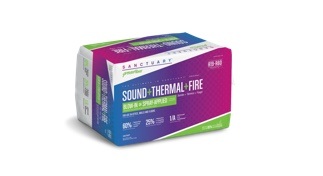
Applegate Insulation is made up of recycled newsprint. These cellulose fibers are then combined with non-toxic, fire-resistant additives in a unique, two-stage liquid/dry manufacturing process. The material may contain a dry adhesive, depending on the product type.

Where can I find an installer?

Applegate Insulation professionals are spread throughout the United States. We'd love to connect you to the professional that best meets your needs. Please fill out the submission form at "Find an Installer in My Area".

Do I still need a housewrap or building paper when using Applegate?

When an insulator combines air seal (caulk or foam) with cellulose wall-spray, housewrap or building paper is not needed to control air movement through the wall. However, this does not at all affect the second purpose that a housewrap or building paper serves: that of a drainage plane. Consideration should still be given to a drainage plane based on the local climate. Some areas of the country receive so much rain that the sheathing beneath the exterior finish will almost certainly become wet. The climate in some of these regions may offer only limited drying potential. In these areas, a drainage plane (which may be considered a "housewrap" is certainly recommended.

Do different installation methods make a difference?

Installation is critical in determining how insulation performs in your home. The walls, ceilings, and floors of your home are full of odd shaped cavities and obstacles like plumbing, air ducts, and wiring. For your insulation to work


effectively, it must completely fill around these obstructions without gaps or voids. Applegate Cellulose Insulation is sprayed or blown into walls, conforming to your home and surrounding you and your family with a seamless insulation system. Fiberglass batts, on the other hand, are cut and pieced together, leaving gaps, voids, & areas of compression. Walls are fully and tightly insulated, forming a monolithic thermal barrier. No more gaps. No more voids. No more drafts. Just years of comfort.

Does Applegate Insulation cost more than fiberglass?

Yes and no. Some insulation professionals estimate that the difference between fiberglass and cellulose insulation could be as little as $250. However, when you consider that Applegate Insulation can deliver greater comfort and energy savings, Applegate becomes the solution. Like an investment, adding Applegate Insulation to your home can provide great payback.

Can Applegate be installed over existing insulation?

Provided that the existing insulation is properly installed and free from defect (moisture damage, mold growth, etc.) Applegate Installation may be installed over existing insulation. In fact, as little as 4 inches of Applegate applied over the fiberglass in your attic will restore the effective R-value of the fiberglass in heating and cooling seasons.

What are the thermal benefits of Applegate?

Applegate Insulation has a higher density than many other insulation types available, providing excellent resistance to air-infiltration, radiation of heat energy and convective currents. Additionally, it has a higher R-value/inch—as much as 3.8-3.9 R/inch depending on product depth and density of application; that means more insulating power with less product.

What is R-value?

R-value is the industry standard for measuring the insulating power of any material; the higher the R-value, the higher the insulating power. But that's only part of the insulation story. More...

What are the sound control benefits?

Sound waves move through the air and space. The same density and custom fit provided by Applegate for the purpose of fire safety and thermal control, also increases its ability to control sound. The one time luxury of insulating interior walls for sound control is now affordable with Applegate Insulation.

What are the fire resistance characteristics?

Applegate Insulation is manufactured and tested by R&D Services (third-party) in accordance with ASTM C739. It meets and exceeds the fire-resistance testing under that government requirement. Additionally, Applegate has Class 1 fire rating under ASTM E84; flame spread: 15; smoked developed: 5. For more information regarding how, in fire tests, Applegate out performs traditional insulation by 55% click here.


Search this Site

What are the fire resistance characteristics?

Applegate Insulation is manufactured and tested by R&D Services (third-party) in accordance with ASTM C739. It meets and exceeds the fire-resistance testing under that government requirement. Additionally, Applegate has Class 1 fire rating under ASTM E84; flame spread: 15; smoked developed: 5. For more information regarding how, in fire tests, Applegate out performs traditional insulation by 55% click here.

Are the fire retardants used in Applegate safe for humans?

The fire retardant additives used to manufacture Applegate are non-toxic. One of the additives, boric acid, is six times less toxic to humans than table salt!

Does the fire retardant lose its effectiveness as the product ages?

No. In fact, it would take 300 hundred years at 100% humidity and temperatures in excess of 150ºF before Applegate would even begin to show signs of losing any of its fire retardancy.

Tips 

  • Do not fill soffits with insulation. 
  • Use soffit vent baffles to allow the soffit to stay open above the insulation for proper air flow. 
  • Insulate the inside of the access hole cover with batt or foam board insulation to complete the job.

Caution!

To help avoid fire: Keep insulation at least 3 inches away from the sides of recessed light fixtures. Do not place insulation over such fixtures so as to trap heat. Also keep insulation away from exhaust flues of furnaces, water heaters, space heaters or other heat-producing devices. To be sure that insulation is kept away from light fixtures and flues, use a barrier to permanently maintain clearance around these items. Check with local building or fire officials for guidance on installation and barrier requirements.

 
Turning yesterday’s news into tomorrow’s insulation.
Applegate insulation 1000 Highview Drive Webberville, MI 48892 800 627 7536 Fax 517 521 3597
content management system by:
Content Management System by Smart Solutions.
"For every house is built by someone, but the builder of all things is God." Heb. 3:4 (NASB)